Ragwort clearance at Basing Common
Learn about what we’re doing and why
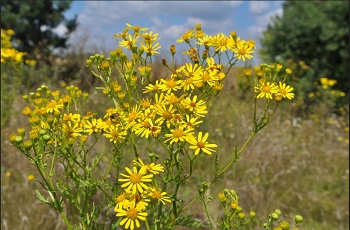
Our Ranger team, Natural Basingstoke and volunteers are pulling together to reduce the spread of ragwort at Basing Common.
Ragwort is a wildflower found on grassland verges and while it has many benefits for wildlife, it is poisonous to horses and other livestock and there are laws in place to prevent its spread. The common is managed through grazing and these horses are at risk if the spread of the ragwort continues, as are neighbouring agricultural fields.
Ready, steady, pull!

Volunteers put on their protective gloves and got stuck in at various volunteering sessions throughout the spring and summer. A huge thank you to the volunteers who joined us to help reduce the ragwort, roots and all!
You might spot conservation groups and Ranger-led volunteering teams hard at work on the common. If you would like to get involved in future sessions, please contact WildlifeConservation@basingstoke.gov.uk
Basing Common will remain open while the ragwort pulling takes place.
- What is ragwort?
-
Ragwort is a wildflower with yellow pollinator-friendly flowers, it is a common sight in the UK countryside and although rarely a problem in gardens, its poisonous nature makes it dangerous for grazing animals.
- Why does ragwort need to be controlled?
-
Ragwort plants produce many thousands of seeds which are widely dispersed. Those in the centre of the flower head have a thatch of hair attached so they can be transported long distances by the wind, while those around the edge are heavier and simply drop to the ground ready to germinate after the parent plant dies.
Ragwort can also regenerate from small sections of root and may be inadvertently spread by digging or moving soil.
- Why is it a problem to have ragwort on Basing Common?
-
Despite its benefit to wildlife, ragwort is listed in the Weeds Act 1959, which gives landowners/occupiers an obligation to control the spread if it poses a risk on land used for grazing horses or forage production.Ragwort contains pyrrolizidine alkaloids – toxins that when ingested in large quantities by horses and other livestock, can cause liver failure and death. These toxins are present whether the ragwort is green or dried.
Basing Common has a number of horses grazing on it. To not control the ragwort would put these animals at risk and neighbouring agricultural fields.
- Will grazing animals eat ragwort?
-
Due to its bitter taste, most horses won’t immediately choose to eat ragwort, but they will eat it if nothing else is available, accidentally, or where parts of the plant have wilted and become palatable. Ragwort loses its bitter taste if it’s cut and dried for example in hay, but it doesn’t lose any of its toxicity and still remains a danger.
- Why has the problem become so bad at Basing Common?
-
Ragwort seeds spread easily and the amount of it on the common has increased steadily over the last few years. Previous attempts to control it have included topping the plants, but this has been unsuccessful. Due to the recent hot, dry summers, soil disturbance from rabbits, and then wet winters, the plant has thrived and spread.
- Can the area be sprayed?
-
Ragwort is a very robust plant. It doesn't respond to glyphosate, which is a biodegradable herbicide and also doesn't respond well to Grazon, a weed killer. The chemicals required to treat it are toxic and need to be administered via a boom. Ecologically, at this point, we wouldn’t want to see heavy chemical applications which could harm other species, including an abundance of wild flowers, various species of invertebrates, and ground nesting birds such as skylarks.. - Can you mow it?
-
No. Mowing chops up and spreads ragwort, making it harder for grazing animals to identify and avoid it. It also stimulates growth.
- How will you deal with the problem?
-
Pulling the plant and its root up is the most effective and least invasive method of dealing with ragwort. This should be done in June when the plants are at seedling or rosette stage and, if possible, after rainfall when the ground is soft.
Therefore, our preferred option is for our Ranger team to run a series of sessions with the support of Natural Basingstoke, our conservation groups, corporate volunteering groups and local residents to pull the plants up, removing the root and preventing grow back.
- Can people still use Basing Common?
-
Yes, the common will remain open for people to use while this work takes place. - What options have been considered?
-
We have consulted the county archaeologist about the possibility of a complete plough, but because of the archaeology from the civil war that lies under the soil, they were very reluctant to give that approval. This course of action would also require planning permission.We have engaged the services of a specialist in weed control on agricultural land and considered options such as closing the site for the summer and also to remove the grazing animals whilst a herbicide treatment is carried out. We are keen to avoid this by removing the weeds by hand. However if this method is ineffective we may need to reconsider this option.
We have also explored spot treating every rosette with handheld applicators, which would have less impact on other non-target flora and fauna. Due to the size of the common, this would take a long time and would have to be repeated in September. It also may not be effective.
- What are you doing with the ragwort you pull out?
-
The Ranger team will collect the pulled ragwort from the common and will take it to a local compost facility.
Sign up for email updates
Receive information on council services, news and events by email.
Subscribe© 2026 Basingstoke and Deane Borough Council