Crabtree and Dickens Lane Woodland Management Project
Crabtree Plantation, Dickens’ Plantation and a large proportion of Crabtree Grassland were formerly part of New Park, created in the 19th century as an extension to Hackwood Park. Crabtree Plantation forms the northernmost part of the Grade I Registered Park and Garden at Hackwood Park. In 2023 Crabtree Plantation was declared as Local Nature Reserve (LNR). The declaration recognised the plantation’s importance for nature conservation and which to improve the plantation’s importance for wildlife and increase public enjoyment.
The reason for woodland management works
The works aim to compensate the loss of the habitats for white helleborine orchids to the residential development at Land adjoining the Spinney, Park Prewett, Aldermaston Road.
Crabtree Plantation and Dickens Lane Plantation were the receptor sites agreed in the Section 106 legal process to benefit from the contribution made under the development, as white helleborines were readily recorded within these two plantations.
- What is white helleborine orchid?
-
The white helleborine orchid is a rare wildflower found in the UK and some parts of Europe. It grows well in shaded areas, such as in woodlands with common beech and English oak trees.
White helleborines are protected under the Wildlife and Countryside Act (1981) from being removed and are classified as Vulnerable on the UK Vascular Plant Red Data List.
- Can people still visit the Crabtree and Dicken’s Lane plantations?
-
Yes. Signs will be put up on site to advise visitors what areas they should not enter around Bolton Arch while felling takes place. Bolton Arch is at the northern tip of Dicken’s Lane Plantation and the eastern part of Crabtree Plantation. Small sections in these areas may be cordoned off at various times while the contractor is working.
Otherwise, visitors can continue to go to and use the areas as normal while the work takes place.
- Where did the funding come from for this project?
-
We are funding this work using financial contributions through Section 106 legal agreement, secured from the developer of the residential development at land adjoining The Spinney, Park Prewett, Aldermaston Road.
Works to be carried out
Tree felling and replanting works is being carried out at the northern tip of Dickens Lane and the eastern section of Crabtree Plantation to deliver the enhanced woodland management and restoration of the area.
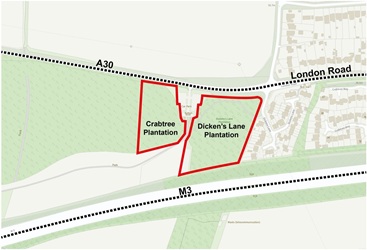
Select image to open a larger version
The map shows the location of the Project Site. It is bound by London Road to the north and M3 to the south. It sits in between two settlements (Black Dam and Old Basing). Bolton Arch (Grade II Listed) once was the entrance to Hackwood Park, now the entrance to Crabtree Plantation.
The works include:
- the felling of non-native trees, including Ash dieback, plus 30% Sycamore trees in order to rejuvenate the woodland to create a suitable habitat for white helleborine orchids
- the tree logs and trunks harnessed from the site being used to mark out the informal walking paths, to minimise human disturbance in habitat sensitive locations.
The Tree Felling License was granted on 2 December 2025, with an expiration date of 2 December 2030.
Replanting the woodland
Following the tree felling, 880 native trees will be planted on site. Species include Common beech, English oak, Hazel and Elm, with the support from the Council’s Ranger Team and volunteer groups.
- Timeline for the tree replanting
-
The ideal time for tree planting is during their dormant season, typically from November to March, as it will be less disturbed for the trees and help their root to establish before the summer. It is advised to avoid soil condition being frozen or waterlogged. We will be working with Natural Basingstoke and volunteers to plant the trees.
- Why we only plant small saplings
-
Studies have shown that young saplings have a much higher success rate. Mature trees are more likely to suffer transplant shock, resulting in the plant failing to root.
Younger trees grow rapidly and will match the size of bigger saplings in under 10 years. Having a good start means they are much more likely to have a strong and healthy future and less likely than older trees to succumb to disease or fall in high winds.
- Watering the trees
-
We can’t water every newly planted tree in a woodland, but we can help them to retain as much moisture as possible.
The tree tubes which surround the trees help to maintain a moist microclimate that will encourage strong growth and protect the young tree from dry spells. They also offer protection from grazing deer, who find young tree tips irresistible.
Mulch mats keep thirsty weeds away from the roots.
We expect that some trees will fail to grow and the amount of planting has been planned with losses in mind. We have spare saplings to add at a later stage in case an extreme dry spell results in a high number of losses.
- Biodegradable tubes
-
The tubes are made of a biodegradable material that will break down naturally in time once they’ve fulfilled their protective role.
Deadwood: A haven for wildlife
At Crabtree and Dickens Lane Plantation some dead trees have been left standing and fallen trees have been left as logs to keep the habitat healthy and diverse.
Wood that is left to rot down creates a whole microworld of habitats within habitats, supporting hundreds and thousands of species that it couldn’t necessarily support when the tree was alive.
- Fungi, mosses, lichens, beetles, slugs, snails are among many species benefitting from different stages of wood decomposition.
- Decaying wood also acts as a shelter for small rodents, reptiles, and amphibians.
- The years of nutrients that the tree stored within itself, will return to the soil, and create nutrients for other species and future or existing trees.
- It is estimated that of the species we know of, at least six thousand rely on deadwood.
Future work
Following the replanting, we will continue to lead on the restoration of plantation in additional phases and careful, on-going monitoring will take place to record the recovery of these woodlands.
If you have any further questions, please get in touch by emailing wildlifeconservation@basingstoke.gov.uk.
Sign up for email updates
Receive information on council services, news and events by email.
Subscribe© 2026 Basingstoke and Deane Borough Council