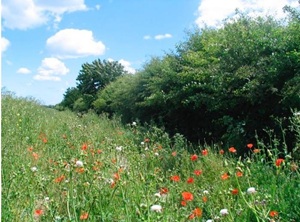
Hedgerows

Hedgerows are linear features of ‘bushy’ tree and shrub species and are crucial to support our native wildlife. They provide food, shelter and nesting opportunities for birds, reptiles, pollinators, and small mammals. What’s more, they are commuting routes for bats and act as corridors to enable animals to travel between different habitats.

Regulations

Certain hedgerows have been protected since 1997 when the Hedgerows Regulations came into force. To preserve these environmentally valuable features it is prohibited to remove all or part of a hedgerow that meet criteria for length, location, and importance.

To find out further information regarding protected trees and high hedges refer to the relevant webpage.

For any other information relating to trees and hedges refer to the relevant webpage.

Criteria

Criteria from any of the following sections must be met for a hedgerow to be lawfully protected.

Length

  • More than 20m long with gaps of less than 20m within
  • Less than 20m long but meets another hedge at each end

Location

The hedge may be on or next to:

  • land used for agriculture or forestry
  • land used for breeding or keeping horses, ponies or donkeys
  • common land
  • a village green
  • a site of special scientific interest
  • a protected European site, such as a Special Protection Area or Special Area for Conservation
  • a local or national nature reserve
  • land belonging to the state

Importance

A hedgerow may be termed important if it is 30 years old or older and has one of the following features:

  • mark all or part of a parish boundary that existed before 1850
  • contain an archaeological feature
  • is completely or partly next to an archaeological site listed on a Historic Environment Record (HER)
  • marks the boundary of an estate or manor that existed before 1600
  • is part of a field system that looks to be related to any building or other feature associated with the field system that existed before 1845 - reword
  • contains protected species listed in The Wildlife and Countryside Act 1981
  • contains species that are endangered, vulnerable and rare identified in the British Red Data books
  • includes woody species and associated features as specified in Schedule 1, Part II Criteria, paragraph 7(1) of the Hedgerow Regulations

Application process

You must apply for a Hedgerow Removal Notice if you are the owner, tenant or manager of the hedgerow and you wish to partake in works that involve the removal of any part of the protected hedgerow, regardless of the desired length of removal.

Even if the hedgerow is not considered ‘important’ you still need to apply for a removal notice.

Application for removal of hedgerow

Notes on how to fill out the application form

Details about the standard application process and fees,

You do not need to apply for a Hedgerow Removal Notice if:

  • the hedgerow is less than 20m long (providing it doesn’t meet another hedgerow at either end)
  • it borders a residential garden
  • you are undertaking standard management work outside of bird nesting season (1 March to 31 August). Management works are those that do not involve the uprooting of plants, such as:
    • coppicing
    • pollarding
    • planting or
    • trimming
  • the removal is to create access to an emergency
  • you are creating a single access point into your land where there was not one previously
  • you are creating another access point providing you replant over the previous gap

Once we have received your application, we have 42 days to respond with either a:

  • hedgerow retention notice stating that you cannot remove any part of the hedge; or
  • written notice stating that you are allowed to proceed with the removal works outlined in your application. Works must be completed within two years from the date of the written notice.

You may appeal our decision within 28 days.

If you receive a written notice permitting hedgerow removal you must first also check whether other statutory restrictions are in place:

  • the Wildlife and Countryside Act 1981 prohibits the destruction and disturbance of nesting birds and so removals should not be carried out during bird nesting season from the 1st March to 31st August and in the case of works carried out a month either side of these dates checks should be made of the hedge for nesting birds.
  • you may need a felling licence prior to works carried out on hedgerow trees. Some trees may also have a tree preservation order on them.
  • the hedgerow may be in a conservation area.
  • there may be restrictions if you are involved in a rural payment scheme (Environmental, Countryside, or Sustainable Farming Incentive Stewardship schemes)
  • the hedgerow may hold European protected species such as Hazel Dormouse or species of bats and checks should be made by qualified ecologists to establish if this is the case, if so a Natural England Protected Species Licence may be required to undertake works.

Hedgerows are an agricultural feature that can provide shelter for livestock and crops and prevent soil erosion across fields by cutting down wind speed. They also provide a rich and varied wildlife habitat, offering shelter, a supply of food, and a route linking different habitats along which wildlife can travel. They are also important in defining field patterns and contributing to the visual character of the landscape.

Take a look at our Hedgerows - a guide to their management leaflet, which sets out suggested guidelines for successful hedgerow management for wildlife. It also includes information on sources of grant funding towards hedgerow restoration.

Enforcement

If you have been found to have breached The Hedgerow Regulations by the unpermitted removal of a protected hedgerow, the Council may do one or both of the following things:

  • give you a replanting notice with details on how to replant your hedgerow to benefit wildlife. You would have 2 years to replant the hedgerow from the date of the notice.
  • the Council may prosecute the person undertaking the works, which can result in a fine of up to £5000.

We welcome consultation with The Council regarding the proposal of a hedgerow removal at any stage of the application. If you have any queries email BiodiversityTeam@basingstoke.gov.uk

Management advice

Hedgerows are an agricultural feature that can provide shelter for livestock and crops and prevent soil erosion across fields by cutting down wind speed. They also provide a rich and varied wildlife habitat, offering shelter, a supply of food, and a route linking different habitats along which wildlife can travel. They are also important in defining field patterns and contributing to the visual character of the landscape.

Please take a look at our leaflet; Hedgerows - a guide to their management, which sets out suggested guidelines for successful hedgerow management for wildlife. It also includes information on sources of grant funding towards hedgerow restoration.

Hedgerows - a guide to their management

Contact details

Biodiversity Team

Help us improve our website

If your feedback is about a council service, please get in touch using our Contact us form

Sign up for email updates

Receive information on council services, news and events by email.

© 2026 Basingstoke and Deane Borough Council